User: How can I better serve you?

Saturday, December 3, 2011

Blog #10

First, off I would just like to say that I love going to a school where the topic of religion isn't ignored and where we are encouraged to keep our faith no matter what career we go in. In fact, it seems that we are tought how to be faithful dispite a world that tells us not to be and to stick to the so called "facts".

Second, I love that we are allowed to be relligious and encouraged to hold to our honor http://www.youtube.com/watch?v=B1xzd9CoX8E. This school has taught me a lot. I doubt that I will ever lose my faith and I think it would be impossible for me to not carry that with me in all that I do--journalism especially. Not that I will be brainwashing my audience with propaganda. No, I can still act upon my religion, have objectivity, and still report a good story.

Third, here is a journalist who is LDS http://www.youtube.com/watch?v=donMKpPhf18. She says "I always find strength in my faith and I think that's what keeps me going and going".

The examples of journalists of our faith and of other faiths is proof that we can keep our faith and still do good journalism. We need not to cast it aside while we are on the job. Our religion is us--whatever this religion may be--it is in us and apart of us. If we can cast it aside for something like a job then we have no real faith.

Fourth, we can colaborate with other journalists who are like us, holding onto the faith, if we feel like we need a support group in a world where religion is often frowned upon. For example, one could attend http://www.youtube.com/watch?v=TwXpcZmUSqQ a conference based on journalists of faith.

Blog #12

Elements Chapter 8 "Engagement and Relevance"

Journalism is hard work--we don't want to become too involved as we fear becoming apart of the story which will somehow take away the objectivity and integrity of what we are writing about.

One of the stories given in this chapter was about R. J. Voigt. His story interests me and so I went and researched him a bit. See http://www.baltimoresun.com/news/bal-angelsjournal,0,5346345.story. The article features a few of Voigt's journal entries. We see this sweet Godly boy who just wants to be happy and can't wait for the one in four weeks when he doesn't have to take his oral chemo treatment. He takes it with apple juice but he still hates the taste of it.

Sure, there is more to this chapter but I guess I was too taken aback by this story. Through the Voigt story we see how people can become engaged, attracted to the story, and it is still relevant to reality. For me, I can relate somewhat. I love good stories and the motivational stories of children's deaths--not that I love children's deaths--that would be atrocious--but I love the story behind the story. Okay, the kid dies but who is this kid, what makes him special, what makes me want to learn about him as a person, to see his struggles, and to see a glimpse of hope for myself and others. That's a story. --One such story like Voight's is the movie Johnny. See trailer: http://www.youtube.com/watch?v=1sYQJfge5eQ.

Minds Chapter 7 discusses celebrity journalists. I don't really know what to say about how I personally feel about this. Sure, as a future journalist the money and fame that would come with the job would be enticing but then whatever I report would not be entirely objective and also what I would report would be for my own gain, rather than the people of whom I would report for. Here is Amy Goodman's take on celebrity journalism http://www.youtube.com/watch?v=fva8YU4iEPY where it basically says that the Iraq war ended celebrity journalism as it has made us so immune to certain stories and we turned our back from the media as we grew tired of the stories, the lies, and the extremism. In all, we turned our back on journalists and the media all together; thus, we ended celebrity journalism. We had lost faith in the media and it's role in democracy in our lives.

Blog #11

Readings: Chapter 9 & 11

Titles: "Make the News Comprehensive and Proportional" & "The Rights and Responsibilities of Citizens".

My discourse on Chapter 9:

I thought it was genius for the teenagers to answer the question of "What do you think the next trend will be?" with "What do you mean, what will the next trend be? We rely on you to  tell us what the next big trend will be". It is so true! We do rely on the media to tell us what will be the next trend and what we will want--kind of discerning, to me, as that doesn't really allow for an individual's full and complete independence. However, of course researchers are the ones who tell us what is trending but I believe that will prove to be too influential. Check out this: http://www.youtube.com/watch?v=g3_rTT9gfnU which tells us some of the hot trends like the Prius PHV. Of course, the research of trends may not come via word of mouth or old-fashioned "pounding the streets for information" like such results used to come out of. No, instead these days a lot of research on trends comes from researchers keeping an eye on the social networks that we use--like Twitter.

A little bit into this chapter it talked about journalists who put too much effort into writing about celebrity scandals because they know it will make a good story. I hate that type of journalism! We, as citizens, get drawn into that stuff, the reason why it sales, and in all perspective it is quite useless. How many of us have heard about the Kardashian divorce, two million dollar ring, the new baby on the way, and any other pitter smatter of their daily lives. I can't even recall why exactly they are famous. They don't sing, dance, act, etc. They just look super good in front of a camera and who knows why they have their own reality TV show? I don't. I am sure there is a reason for their fame but it is pretty nonexistent now. (sorry for my banter on these celebrities--I have a personal distaste for them). For any of you who may be wondering why they are famous just watch this http://www.youtube.com/watch?v=VYuwfohfflU video and you will see not only how pointless their fame is but also how exactly this family just makes for good stories. After all, their fame started out with an over-publicized sex tape, or it pretty much did anyway.

My discourse on Chapter 11:

Information helps people become informed citizens and "public opinion, in turn, made possible the rise of self-government" (book, page 247). Basically, journalism and democracy came together. I am a big fan of democracy, but like the chapter heading of the "Responsibilities of the Citizens" I am no fan of much responsibility so my first question is "What exactly are these responsibilities?". I mean, as a present citizen I do not want any more responsibility than I can currently handle.

The following is a list of responsibilities:

On truthfulness: "The citizen has an obligation to approach the news with an open mind and not just a desire that the news reinforce existing opinion".

On loyalty to citizens: be transparent in giving information

On Independence: no divided loyalties

On monitoring power: news sources should be focused on the major issues, rather than the minor issues.

A Public Forum: our views and values should be reflected in the news

On Proportionality and Engagement: keep things simple, not over-exaggerated, and to be read or viewed in a timely manner.--Even these kids know when the news is being exaggerated. This is a video of some random kids and their rendition of the news http://www.youtube.com/watch?v=vNiK_2CcUzY

Tuesday, November 15, 2011

Last Class

Last class was pretty interactive although I am not too sure what we learned directly aside from learning to think critically about articles. As I am unsure of how to go about writing this blog entry and being able to add certain external links I will do my best

First, let me introduce you to my all time favorite TV show "19 Kids and Counting". http://www.youtube.com/watch?v=ER69OXzenVE They are expecting baby number twenty.

Why do I introduce this randomness? Well, besides the fact that I am so excited for it I thought that I could use the "10 Questions" given to us in class that could help me to write about this subject if I were to do so. I think you can use these questions for just about anything journalistic related so please forgive if I am off from the way that these questions were meant to be used for.

Question 1: What do I know? What do I know? Answer: The Duggar family includes 19 children, two grandchildren, one in-law, and two parents--all are biologically connected. Also, as stated above they will be expecting baby #20.

Question 2: What is my journalistic purpose? Answer: To inform the public about this family as it is a major milestone for any family.

Question #3: What are my ethical concerns? Answer: To show this family in the best of light as to not create conflict or to isolate myself or my news corporation (if I had one) from being able to report on this family from a personal interaction perspective. (You really don't want to be reporting the story like this guy http://www.youtube.com/watch?v=PUJgLxDqfBc --WARNING: extreme dumbness/some foul language. Also, you may want to stop after the first minute and a half--actually you really do want to/should)

Question #5: How can I include other people, with different perspectives and diverse ideas, in the decision-making process? Answer: Easy! Get their intake! A lot of times on the Duggar show they interview people outside of the show to get their intake on certain things Duggar-related. http://www.youtube.com/watch?v=9SsLgHr5rSk skip to 4:30 so that you can get to the different perspectives part. This link shows the Duggars at a creationist museum and also shows other people disputing the subject.

Tuesday, November 8, 2011

We Are Superheroes!

I really really really enjoyed the group's presentation. Especially Jordan's hilarious remarks concerning rugby, his accent, etc--the things he gets away with just because he's from New Zealand!!! Not sure what I learned exactly (with his and everyone else's presentation) but I do know that I enjoyed it a lot.

On one of Jordan's (I think) slides there were pictures of Spiderman, Captain America, and Bat Man who supposedly had something to do with the journalism field. The main thing that I got out of that presentation was that we need to be truth tellers and superheroes for the people; basically, we need to be the person that the public trusts.

picture of superheroes: http://thebatmanuniverse.net/image/Misc/Blog/Indivdual%20Posts/Dave/Situation%20Room%20Heroes.jpg

It got me thinking. The people trust us, right? Sure they do! Yeah, there is no such thing as "real" superheroes with spider webs shooting out of our wrists, capes that make us fly, or shields that give us power BUT we can be the person who saves the day. With what you may ask--with truth: "The whole truth and nothing but the truth. So help [us] God."--courtrooms of America

Screamo song about "the whole truth": http://www.youtube.com/watch?v=a7pgYHkhUpE please note that you may need a screamo to interpret it for you; otherwise, you may only understand the parts where it says "We want the truth! The whole truth and nothing but the truth!"

As people "We want the truth!" or do we not? I think we do. We demand it. Without it, we succumb to ignorance and allow others to eventually override our independence. As journalists, we need to rip away people's chains of ignorance and to save them from it. We need to give them back their independence. Sure, they can question us and our information--we should welcome that. Afterall, we are the heroes of truthc and even heroes need to be kept on the right path.

Side note: growing up, my favorite tv shows to watch were courtroom related. Judge Judy has to be my all time favorite. http://www.youtube.com/watch?v=bH57MnJIjkc I love it when she says "I am a truth machine, Sir", "Liar, liar, pants on fire! Don't be a liar!", and "I eat liars for breakfast". I find it pretty entertaining how people can give an oath to tell the truth and then they do not. I think that we are obligated to give the truth and that as truth heroes we need to make sure that we always tell truth. We need to make it our personal oath to tell the truth, "the whole truth and nothing but the truth so help [us] God"--AND we need to make sure that we do live by that oath. Otherwise, just like these people in Judge Judy's courtroom it will come back to bite us in the arse because it will shatter our repuatations as the people do not like being lied to.

Monday, October 31, 2011

Long Live Truth!

Not sure what I learned in class exactly. It was the same stuff that I covered in my Comms101 class the first day and so i felt pretty much familiar with what was talked about.

We talked about loyalty. The notes I took for this part read "Where does loyalty lie—with your old personal friends and colleagues, with your political ideology or party, with your news medium, with the cold facts—or with The Truth". That got me thinking on a personal level. For me, throw the friends and colleagues out the window. As an advocate of individualism, I believe that loyalty to them (when it comes to writing) only holds you back and more or less conforms you to a particular set of ideologies. The same goes for political party but I am uncertain when it comes to political ideology. One can own their own political ideology without it necessarily conforming to a party's official standards/ideals/beliefs. New Medium? No. Cold facts? No to that too. Truth? Absolutely! However, I believe that one should be true to themselves and express the truth that they see with the utmost integrity whether or not it may coincide with their political ideology. The truth may be what the friends, colleagues, political party, news medium, and cold facts stand by but the most important thing is that the truth prevails. Long live truth!!

We also discussed William Safire who was a speech writer for Nixon and he also moved from being a political party writer to being a journalist. Basically, this is a "no no" because the journalist would then be biased as a writer when it comes to politics.

Safire Interview: http://www.youtube.com/watch?v=gIWCZ5qMuDY

Safire's death: http://www.youtube.com/watch?v=7WXGFGtJv9Y (note he died via cancer--just a side note)

Safire's political bias: http://www.youtube.com/watch?v=A9E1BPX8MHM

Tuesday, October 18, 2011

I am Anti-Change; thus, I dislike the "New Goals for Journalists" stuff

Okay, well I am not entirely anti-change. Really, I am only when it affects me. The following are the list of "New Goals for Journalists" as discussed in class (I have only listed the ones I dislike):
  •   Impulse to publish news simply because it is already “out there”
  • Journalists can get away with not doing investigation
  • Journalists spend more time finding the existing news, rather than discovering and cerifying new facts
  • Journalists risk becoming more receivers than gathers (passive vs active)
Example of a gather: http://tinyurl.com/3tfzbmd where journalist is under combat as he is gathering information. Clearly, he is not on the receiving end of the information as he is experiencing it/seeing it first hand. Here is my favorite example of an active journalist: http://www.youtube.com/watch?v=On4OE9Ikb4U. This journalist risks his own freedom to document the Taliban up close and personal. He was allowed to shoot this documentary before he was captured by them.

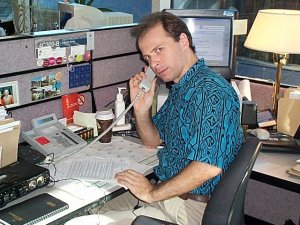
http://colman.net/desk.jpg Although this journalist is in all actuallity an award winning investigative journalist in Toronto, this picture shows him on the receiving end of journalism.

What is the point of even being a journalist if you are going to go by these "goals"? I do not see much to it. Who wants to read something that is already out there? I most certainly do not. Who wants to keep seeing the same news over and over? Not me. Journalists, in my opinion, need to investigate. they need to find new news. Old news is not really news at all. Existing news might as well be old news. Also, as a future journalist, I think I would be very bored if I were to become just a receiver and not a gather. The reason why I chose this careerfield is because I am big into the idea of "snooping around", investigating, uncovering truths, exploiting truths, and perhaps even being held responsible for truth being brought into the general public.

Honestly, the reason why I decided to become a journalist was because of the notion that I could get fully involved in it. I craved the action. I saw those journalists on the news after 9/11 who were about to get beheaded by the Taliban and I thought to myself "They are the martyrs of truth" and besides the martyr part, I wanted to be just like those journalists--always standing for truth.

Monday, October 10, 2011

Separated Journalists and Confidentiality

The group that presented talked about "Separated Journalists" which completely goes against my ideal image of a journalist. Journalists tend to be separated journalists as a matter of emotions self-preservation and they feel that they must then separate themselves from the rest of community. At least, this is what I got out of the presentation. I do not think that I can be a separated journalist because I firmly believe in getting involved with the community. As a consumer of the media I am least likely to trust a journalist who in uninvolved as I feel like "how can they possibly write about this? They don't understand. They haven't experienced it. They are just on the sidelines." Maybe if journalists were not separatists then the print media would be of higher interest to media consumers and wouldn't die off as quickly as it is.

In this YouTube video, a journalist gets punched in the face by Canadian police. The journalist, as made clear in this video, was not a separatist. He was in the middle of the protests and not simply on the sidelines. Thus, he was more active than separate. http://www.youtube.com/watch?v=D7OA920pbv8

The part of the presentation on confidentiality is one that I can somewhat relate to. As a person who has lived through certain events and has certain people who would like to find me in the near future for certain reasons, I really do not want my name to be publicized too much. As a future writer/journalist this is something I will have to battle with as my name will be used in publishing most likely. However, I have been on the part of the source's side where I needed the confidentiality. I was raised to fear what the media could do to my reputation and what consumers could do to the information given.

This YouTube video is a Grad student who, I believe, is not a journalist, but she talks about confidentiality when it comes to publishing. She says that maintaining people's right to confidentiality is a part of being an "open professional": http://www.youtube.com/watch?v=wjvxWatjrT8

Another issue that stems from confidentiality is what happens when the media fails to protects a confidential source. This video discusses this issue and talks about a certain case and the results of the breech of confidentiality. http://www.youtube.com/watch?v=ySHwABcSPXw

Tuesday, October 4, 2011

Another Media Study

Well, I was not that impressed with the New York Times article assigned to our class to read and blog about (http://tinyurl.com/3e56go3) titled "Pew Media Study Shows Reliance on Many Outlets". Why was this? NYT is supposed to deliver news--not something that everyone can determine by simple observation. To me, this article was as useless as if they had written an article on how grass actually grows in dirt. Who knows, maybe they have written an article on that.

Okay, enough of my cynical behavior. We, the audience of the media, do look to TV news for simple things like weather, traffic reports, et cetera. Why? In my opinion, it is because we have always been able to trust the fact that that information would be available on the television. We can find other information (NYT rates this as the second most common means of news distribution) through the likes of conversation, Twitter posts, and text messages.

Note: Although the way that news is distributed, technology will never take over personal conversation as us humans talk when we talk due to our need for social interaction. Modern technology was built to fulfill that need. One way of distributing news may take over another way, but it will never take over good old fashioned talking.

Pew Research Center, finder of the studies written about in the Article, studies a vast amount of social topics. If you are interested please see http://pewresearch.org/ for more information on them and their studies.

The John S. and James L. Knight Foundation is the organization partnered with Pew for the studies concerning media outlets discussed in the article. The organization's website is http://www.knightfoundation.org/ for all who are interested in their purpose.

Both organizations contribute a lot to society and despite my original reaction (see first paragraph) their findings are pretty useful when it comes to understanding who we are as a society and what we will become.

The Big Five

In my readings of The Elements of Journalism (http://tinyurl.com/ylk9m4u) I have come to a new found respect for the five characteristics discussed:

  1. The Owner/Corporation must be committed must be committed to citizens first
  2. Hire business managers who also put citizens first
  3. Set and communicate clear standards
  4. Journalists have final say over news
  5. Communicate clear standards to the public
(for reference please see pages 70-73 of the book mentioned above which is by the authors Bill Kovach and Tom Rosenstiel)

The first characteristic is important due to the fact that citizens, who are the consumers are put first. However, besides this as it protects the independence of the journalists who cater to the citizens and not to the corporation. With a few exceptions, it seems that the journalism industry is losing all independence as corporate greed is taking its seat of our ever evolving "Pro-Corporate Reich" and destroying the real meaning of Journalism.

Characteristic number two is vital as a manager who puts the citizens first will have greater respect for the journalists of whom the audience [citizens] consume their information from. The management would then be more about the consumers [citizens] than about the "mulla", power, and other greedy incentives often found in a business.

Note: please see this YouTube video on media trust. If you are up to date with your BBC media you will understand how this relates to characteristics one and two. Corporate greed got a hold of the media and what citizens were being exposed to happened to not be the truth. http://tinyurl.com/6cb2pkr

Number three is more than important. In fact, it is vital! With no clear standards there might as well not be standards at all as unclear standards allow for "loop holes" and other problems

Number Four: Oh, yeah, us journalists have the final say! Power in us! Okay, maybe not completely. We will still have that guy who we call our boss only because he signs our paycheck, right? Well, at least this concept is respected as without it being respected then corporate greed would be able to manipulate the media and, therefore, the citizens who put their trust in the media.

Characteristic number five is pretty important as people will usually only consume from sources that they trust and they are more likely to trust a media source who flat out says "These are our standards and we follow them".

In the first paragraph of the section concerning the fifth characteristic there was a segment from the speech of Edward Seaton. I was so intrigued that I decided to look it up online. It basically expands on what he already said in his quote. My favorite quote by him is "Without ethics, there is no quality. Without quality, there is no credibility, and without credibility, there is no future."

Here is the link: http://tinyurl.com/5vzqfau

Tuesday, September 20, 2011

ATTACK WATCH

With every class I become more excited to join the field of Journalism in the future. Truth and Journalism was the subject of my group's presentation today. My particular part in the presentation was on censorship and verification. While researching for this presentation I realized that I love truth and giving it out but I also do believe in some censorship for the protection of our nation as a whole.

There is a song called "Have You Forgotten" by David Worley (http://www.youtube.com/watch?v=p6yLQRF-cEU) about September 11th and in it, it says "They took all the footage off my TV. Said its too disturbing for you and me. It'll just breed anger. That's what the experts say. [If] it was up to me I'd show it every day." I remember 9/11 and how you could not turn on your TV without finding some footage of the attacks on it. A part of me thinks that censorship should not occur in a situation like that; however, another part of me thinks that censorship is necessary. I mean, my parents sent me to school for the next two weeks and the only thing we did was sit in a dark classroom watching the news and watch as the death toll grew. My teacher told our class that basically our country was going to war and that it would be a long one. Many of us, he said, would have family fight and die in it or we would even be able to be apart of it one day. To us, the news put our faith in his prediction which eventually held to be true. Although this teacher was radical in what he taught us, my point by sharing this is that it is my honest opinion that a classroom of nine year-olds should not be watching the gloominess 9/11-type news. It takes away innocence in the young. Should there have been more censorship with 9/11? Maybe, if you consider the youngest of viewers. Should there have been less censorship in consideration to when the footage got taken off the TV? I really do not know. News is not really news if it happened months ago and so the media industry most likely moved on to other topics.--Like I will do right now.

In my presentation, I talked about AttackWatch which is Obama's "Snitch Line" or so it is being called by the conservatives. Basically, it is a website supported by Obama's 2012 campaign where the average person can report those who are "lying" about or opposing him, his views, or his administration. Why do I put parentheses around the word? It is not because I side with the opposition--which, by the way, I do--but it is because in politics a Republican says that a Democrat lies and a Democrat says the Republican lies. Truly, there is "opposition in all things" (2 Nephi 2:11 http://lds.org/scriptures/bofm/2-ne/2.27?lang=eng).

For those of you readers who are interested in AttackWatch (either for the purpose of mere interest or for the purpose of supporting it) the website is as follows: http://www.attackwatch.com/

Tuesday, September 13, 2011

Twitter This And Twitter That

I guess by now you have all figured that we should all have a twitter account for this class. If you have yet to realize this then you have either been "sluffing", sleeping, and/or dead for today's class. No problem, for you, because here is what you need to know:

To get a Twitter account go to http://twitter.com/ and where it says "New to Twitter? Join today!"--you then (can you guess what is next?) join today! You can then "tweet" about events and whatnot. Also, to connect to the class you need to use a hashtag--the symbol that looks like a tic-tac-toe grid--and put Comms239 after it (#Comms239). Today, there were some humorous tweets about class, such as the following:

"Can we go on a class field trip to "the creepiest place on earth" in South Korea?"--Jason Ludlow (a fellow       student of ours mentioned having gone to a part of South Korea where it was pretty similar to North Korea and was the originator of this tweeters quote.
"This is not a negative comment"--Ian Jones
"I'm taking a quiz and being encouraged to tweet at the same time. This is awesome."--Jessica Swenson
Also, another part that one needs to know for this class is how to use  http://tinyurl.com/. This site provides us with a tool that shortens our often lengthy url links that we post on twitter. Don't worry about me not explaining this site because it is pretty much self explanatory.

Even though I am of the generation that is almost entirely engulfed in technology at just about every aspect of our lives, I am not one who generally supports Twitter. To me, it is a waste of time and detrimental to personal security--not to mention to our lives and the way that we communicate. This next site explains this and tells us five things that we can do to balance our lives in the world of social media networks. The five tips are:


  • "Restrict membership to three or four social media networks 


  • Interact as if still living in the year 2005


  • Set an annual budget for the purchase handheld electronic devices, whether for work or pleasure, of .5% of gross annual income


  • Turn off handheld electronic devices while interacting with other human beings, driving a motor vehicle, and at the cinema or theater


  • Attend a 12 step program"

  • http://alvinstarkman.suite101.com/social-media-networks--facebook-twitter--destroying--society-a378038

    or in tinyurl format: http://tinyurl.com/62lb9ga


    Friday, September 9, 2011

    The Generals in the "War of Words"

    On one of the powerpoint slides in class were two collumns. One collumn listed "Federalists" and the other listed "Anti-Federalists". Upon seeing this, I had immediate flashbacks to my high school AP US History class where I learned that a federalist is one who supports the distribution of power between the people and the government. However, in class on Tuesday it came to my realization that that might have been the Federalist belief, but the government and those of the media world during that time did use the media to influence the people of their political ideologies.

    John Fenno, editor and publisher or the "Gazette of the United States", acted as a major figure in the late 18th century. One may even call him a general in the "war of words" that he helped to lead during a time when partisan press exploded and turned from a few intellectual's opinions to real change in the American political system.

    Another general in the "War of words" was Phillip Freneau. He was an Anti-Federalist (a person who was against the US Consititution as it did not contain a Bill of Rights and because they believe in the concept of the central government being equal to or inferior to a state government). Freneau served the American people as the editor of the "National Gazette" and has gone down in history as the "poet of the American Revolution". Often he took part in the partisan press on the right-leaning side of Jeffersonian Democracy.

    Fenno and Freneau may have been two opposing generals in the "war of words", but they became leading figures in the partisan press which helped to mold and shape American politics.

    Link on John Fenno: http://www.personal.psu.edu/sah6/Fenno.html
    Link on Philip Freneau: http://www.csustan.edu/english/reuben/pal/chap2/freneau.html;