User: How can I better serve you?

Monday, October 31, 2011

Long Live Truth!

Not sure what I learned in class exactly. It was the same stuff that I covered in my Comms101 class the first day and so i felt pretty much familiar with what was talked about.

We talked about loyalty. The notes I took for this part read "Where does loyalty lie—with your old personal friends and colleagues, with your political ideology or party, with your news medium, with the cold facts—or with The Truth". That got me thinking on a personal level. For me, throw the friends and colleagues out the window. As an advocate of individualism, I believe that loyalty to them (when it comes to writing) only holds you back and more or less conforms you to a particular set of ideologies. The same goes for political party but I am uncertain when it comes to political ideology. One can own their own political ideology without it necessarily conforming to a party's official standards/ideals/beliefs. New Medium? No. Cold facts? No to that too. Truth? Absolutely! However, I believe that one should be true to themselves and express the truth that they see with the utmost integrity whether or not it may coincide with their political ideology. The truth may be what the friends, colleagues, political party, news medium, and cold facts stand by but the most important thing is that the truth prevails. Long live truth!!

We also discussed William Safire who was a speech writer for Nixon and he also moved from being a political party writer to being a journalist. Basically, this is a "no no" because the journalist would then be biased as a writer when it comes to politics.

Safire Interview: http://www.youtube.com/watch?v=gIWCZ5qMuDY

Safire's death: http://www.youtube.com/watch?v=7WXGFGtJv9Y (note he died via cancer--just a side note)

Safire's political bias: http://www.youtube.com/watch?v=A9E1BPX8MHM

Tuesday, October 18, 2011

I am Anti-Change; thus, I dislike the "New Goals for Journalists" stuff

Okay, well I am not entirely anti-change. Really, I am only when it affects me. The following are the list of "New Goals for Journalists" as discussed in class (I have only listed the ones I dislike):
  •   Impulse to publish news simply because it is already “out there”
  • Journalists can get away with not doing investigation
  • Journalists spend more time finding the existing news, rather than discovering and cerifying new facts
  • Journalists risk becoming more receivers than gathers (passive vs active)
Example of a gather: http://tinyurl.com/3tfzbmd where journalist is under combat as he is gathering information. Clearly, he is not on the receiving end of the information as he is experiencing it/seeing it first hand. Here is my favorite example of an active journalist: http://www.youtube.com/watch?v=On4OE9Ikb4U. This journalist risks his own freedom to document the Taliban up close and personal. He was allowed to shoot this documentary before he was captured by them.

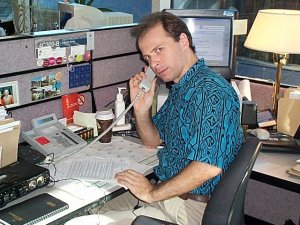
http://colman.net/desk.jpg Although this journalist is in all actuallity an award winning investigative journalist in Toronto, this picture shows him on the receiving end of journalism.

What is the point of even being a journalist if you are going to go by these "goals"? I do not see much to it. Who wants to read something that is already out there? I most certainly do not. Who wants to keep seeing the same news over and over? Not me. Journalists, in my opinion, need to investigate. they need to find new news. Old news is not really news at all. Existing news might as well be old news. Also, as a future journalist, I think I would be very bored if I were to become just a receiver and not a gather. The reason why I chose this careerfield is because I am big into the idea of "snooping around", investigating, uncovering truths, exploiting truths, and perhaps even being held responsible for truth being brought into the general public.

Honestly, the reason why I decided to become a journalist was because of the notion that I could get fully involved in it. I craved the action. I saw those journalists on the news after 9/11 who were about to get beheaded by the Taliban and I thought to myself "They are the martyrs of truth" and besides the martyr part, I wanted to be just like those journalists--always standing for truth.

Monday, October 10, 2011

Separated Journalists and Confidentiality

The group that presented talked about "Separated Journalists" which completely goes against my ideal image of a journalist. Journalists tend to be separated journalists as a matter of emotions self-preservation and they feel that they must then separate themselves from the rest of community. At least, this is what I got out of the presentation. I do not think that I can be a separated journalist because I firmly believe in getting involved with the community. As a consumer of the media I am least likely to trust a journalist who in uninvolved as I feel like "how can they possibly write about this? They don't understand. They haven't experienced it. They are just on the sidelines." Maybe if journalists were not separatists then the print media would be of higher interest to media consumers and wouldn't die off as quickly as it is.

In this YouTube video, a journalist gets punched in the face by Canadian police. The journalist, as made clear in this video, was not a separatist. He was in the middle of the protests and not simply on the sidelines. Thus, he was more active than separate. http://www.youtube.com/watch?v=D7OA920pbv8

The part of the presentation on confidentiality is one that I can somewhat relate to. As a person who has lived through certain events and has certain people who would like to find me in the near future for certain reasons, I really do not want my name to be publicized too much. As a future writer/journalist this is something I will have to battle with as my name will be used in publishing most likely. However, I have been on the part of the source's side where I needed the confidentiality. I was raised to fear what the media could do to my reputation and what consumers could do to the information given.

This YouTube video is a Grad student who, I believe, is not a journalist, but she talks about confidentiality when it comes to publishing. She says that maintaining people's right to confidentiality is a part of being an "open professional": http://www.youtube.com/watch?v=wjvxWatjrT8

Another issue that stems from confidentiality is what happens when the media fails to protects a confidential source. This video discusses this issue and talks about a certain case and the results of the breech of confidentiality. http://www.youtube.com/watch?v=ySHwABcSPXw

Tuesday, October 4, 2011

Another Media Study

Well, I was not that impressed with the New York Times article assigned to our class to read and blog about (http://tinyurl.com/3e56go3) titled "Pew Media Study Shows Reliance on Many Outlets". Why was this? NYT is supposed to deliver news--not something that everyone can determine by simple observation. To me, this article was as useless as if they had written an article on how grass actually grows in dirt. Who knows, maybe they have written an article on that.

Okay, enough of my cynical behavior. We, the audience of the media, do look to TV news for simple things like weather, traffic reports, et cetera. Why? In my opinion, it is because we have always been able to trust the fact that that information would be available on the television. We can find other information (NYT rates this as the second most common means of news distribution) through the likes of conversation, Twitter posts, and text messages.

Note: Although the way that news is distributed, technology will never take over personal conversation as us humans talk when we talk due to our need for social interaction. Modern technology was built to fulfill that need. One way of distributing news may take over another way, but it will never take over good old fashioned talking.

Pew Research Center, finder of the studies written about in the Article, studies a vast amount of social topics. If you are interested please see http://pewresearch.org/ for more information on them and their studies.

The John S. and James L. Knight Foundation is the organization partnered with Pew for the studies concerning media outlets discussed in the article. The organization's website is http://www.knightfoundation.org/ for all who are interested in their purpose.

Both organizations contribute a lot to society and despite my original reaction (see first paragraph) their findings are pretty useful when it comes to understanding who we are as a society and what we will become.

The Big Five

In my readings of The Elements of Journalism (http://tinyurl.com/ylk9m4u) I have come to a new found respect for the five characteristics discussed:

  1. The Owner/Corporation must be committed must be committed to citizens first
  2. Hire business managers who also put citizens first
  3. Set and communicate clear standards
  4. Journalists have final say over news
  5. Communicate clear standards to the public
(for reference please see pages 70-73 of the book mentioned above which is by the authors Bill Kovach and Tom Rosenstiel)

The first characteristic is important due to the fact that citizens, who are the consumers are put first. However, besides this as it protects the independence of the journalists who cater to the citizens and not to the corporation. With a few exceptions, it seems that the journalism industry is losing all independence as corporate greed is taking its seat of our ever evolving "Pro-Corporate Reich" and destroying the real meaning of Journalism.

Characteristic number two is vital as a manager who puts the citizens first will have greater respect for the journalists of whom the audience [citizens] consume their information from. The management would then be more about the consumers [citizens] than about the "mulla", power, and other greedy incentives often found in a business.

Note: please see this YouTube video on media trust. If you are up to date with your BBC media you will understand how this relates to characteristics one and two. Corporate greed got a hold of the media and what citizens were being exposed to happened to not be the truth. http://tinyurl.com/6cb2pkr

Number three is more than important. In fact, it is vital! With no clear standards there might as well not be standards at all as unclear standards allow for "loop holes" and other problems

Number Four: Oh, yeah, us journalists have the final say! Power in us! Okay, maybe not completely. We will still have that guy who we call our boss only because he signs our paycheck, right? Well, at least this concept is respected as without it being respected then corporate greed would be able to manipulate the media and, therefore, the citizens who put their trust in the media.

Characteristic number five is pretty important as people will usually only consume from sources that they trust and they are more likely to trust a media source who flat out says "These are our standards and we follow them".

In the first paragraph of the section concerning the fifth characteristic there was a segment from the speech of Edward Seaton. I was so intrigued that I decided to look it up online. It basically expands on what he already said in his quote. My favorite quote by him is "Without ethics, there is no quality. Without quality, there is no credibility, and without credibility, there is no future."

Here is the link: http://tinyurl.com/5vzqfau